Budgetary Costs of U.S. Military Operations in Venezuela, the Caribbean, and the Eastern Pacific, August 1, 2025 – March 31, 2026
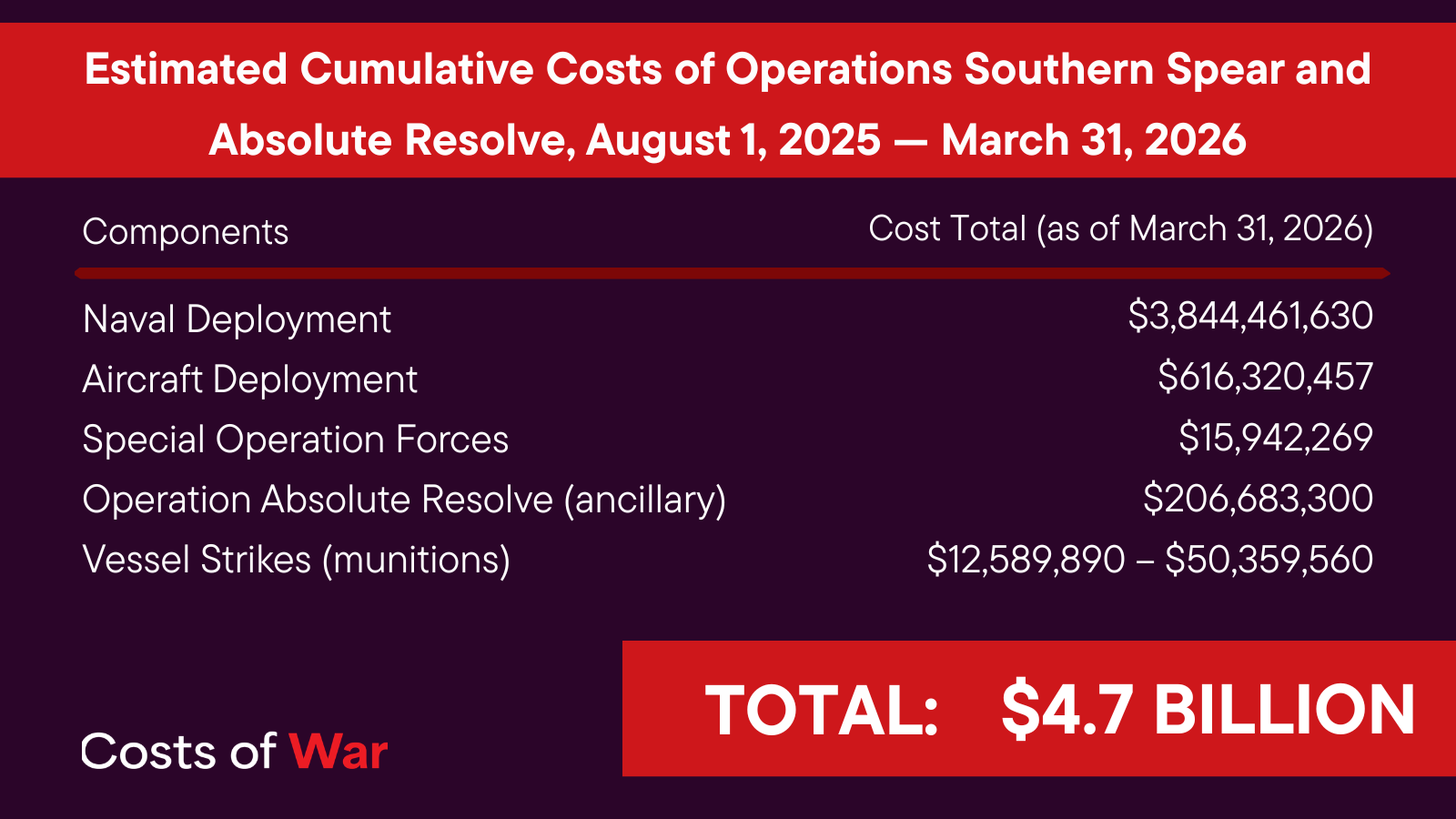
Hanna Homestead (Research Analyst with the National Priorities Project) and Jennifer Kavanagh (Senior Fellow & Director of Military Analysis at Defense Priorities) found that spending on Operation Southern Spear and Operation Absolute Resolve in Venezuela, the Caribbean, and the Eastern Pacific cost at least $4.7 billion from August 1, 2025-March 31, 2026. Costs will continue to mount as some naval assets and aircraft remain in the region and strikes continue. This estimate is only partial due to lack of information, and does not include long-term budgetary costs such as veterans benefits.
Classifying cartels as terrorist organizations paved the way for expanding U.S. forces in the U.S. Southern Command area of responsibility and eventual military aggression against Venezuela's President Maduro.
The $4.7 billion total spending is comprised of the following figures:
- Naval deployment: $3,844,461,630
- Aircraft deployment: $616,320,457
- Special operation forces: $15,942,269
- Operation Absolute Resolve (ancillary): $206,683,300
- Vessel Strikes (munitions): $12.6 million - $50.4 million
The human costs of these operations are also significant. While the report does not focus on the topic, it notes that the raid and capture of Venezuelan President Nicolás Maduro during Operation Absolute Resolve resulted in approximately 75 known fatalities. U.S. military strikes against unarmed vessels in the Caribbean and Eastern Pacific between September 2, 2025 and March 31, 2026 have killed at least 163 people. In addition, at least one American service member died while deployed to the Caribbean in February 2026 when two U.S. ships collided.
To date, Congress has not authorized the use of force in the Caribbean or Eastern Pacific and the Pentagon has not provided information about costs of Venezuela-related operations, even as they continue to mount.
-
Hanna Homestead (she/her) is a Research Analyst with the National Priorities Project (NPP) at the Institute for Policy Studies. Her work focuses on right-sizing the federal budget to prioritize human and ecological security, including examining the intersections of climate crisis, capitalism, and militarism. With a strong commitment to social and environmental justice, Hanna’s professional experience in public policy, organizing, and program management spans various sectors and geographical locations. Prior to joining NPP, Hanna helped establish and direct the Climate and Militarism Program at the Center for International Policy, advocated for sex work decriminalization in Wisconsin, and served as a Global Health Corps fellow in Kasese, Uganda. She earned her Master’s degree in International Security Policy at Columbia’s School of International and Public Affairs (SIPA), and a Bachelor’s degree from the University of Wisconsin-Madison.
-
A political scientist by training, Kavanagh has spent her career studying U.S. national security and defense policy. Kavanagh’s research focuses on U.S. military strategy, force structure and defense budgeting, the defense industrial base, and U.S. military deployments and interventions.
Previously, Kavanagh was a senior fellow in the American Statecraft Program at the Carnegie Endowment for International Peace. She also worked as a senior political scientist at the RAND Corporation, where she led projects for defense and national security clients. She served for three years as director of RAND’s Army Strategy program. Her work has been published in Foreign Affairs, The New York Times, Foreign Policy, Journal of Conflict Resolution, The Washington Quarterly, Lawfare, Los Angeles Times, and War on the Rocks, among other outlets.
Kavanagh received an AB in Government from Harvard University and a PhD in Political Science and Public Policy from the University of Michigan. She is also a term member of the Council on Foreign Relations and an adjunct professor in the Security Studies Program at Georgetown University.